
ACE Gutters and Colorbond are not the same kind of thing, which is why comparing them can be confusing. ACE Gutters is an Australian manufacturer — the company that makes the Nu-Line all-in-one fascia gutter profile found on a lot of older Queensland homes. Colorbond is a pre-painted steel product made by BlueScope, used to make roofing, fascia and gutters among other things. One is a maker of a system; the other is a material.
So when someone searches ace gutters vs colorbond, the real question underneath it is almost always this: my old roofline has failed, what goes back on in its place, and how is the new one different? That is what this article answers.
What ACE Gutters actually is
ACE Gutters is a roll-forming manufacturer. Nu-Line is one of their profiles — a single folded steel section designed to do the fascia’s job and the gutter’s job at once. Roof sheets lap onto the top of it, it covers the rafter ends, and it carries the water away, all in one continuous piece.
It is worth saying plainly that this was a sensible piece of design for its time. One product instead of two, one install instead of two, a clean straight roofline with no visible fascia board, and a faster build. Plenty of Queensland homes went up with it and it did the job for a very long time. The problem that shows up decades later is not that the product was poor — it is that the part which eventually rusts is also the part holding the roof edge together, so there is no way to deal with the rust in isolation.
What Colorbond actually is
Colorbond is BlueScope’s pre-painted steel. It is not a gutter design and it is not a roofline system — it is the coated steel that gutters, fascia covers, roof sheeting, flashings and downpipes are formed from. When a roof plumber says a house is getting Colorbond guttering, they mean the new gutter is being rolled or supplied in that material, in a chosen profile and colour.
That distinction matters because it means Colorbond is not the replacement for Nu-Line in the way people expect. The replacement is a different arrangement of the roofline — a separate fascia and a separate gutter — and Colorbond is commonly what the new gutter is made of.
So what is really being compared?
Strip the brand names away and the genuine comparison is between two ways of building the edge of a roof:
- The all-in-one approach — one steel section doing both jobs. Fewer components, faster to install, no visible fascia board.
- The conventional approach — a fascia fixed to the rafter ends, with a separate gutter hung off it on brackets. More components, but each one is independent of the other.
Everything a homeowner cares about — what happens when it leaks, what happens when it rusts, what happens in twenty years — follows from that one structural difference.
How the two compare for a homeowner
| Factor | All-in-one (Nu-Line profile) | Separate fascia + Colorbond gutter |
|---|---|---|
| Components | One section performs both roles | Fascia and gutter are independent parts |
| Fixing a leak | Cannot be dealt with in isolation — the failing part is structural | The bad run is cut out and replaced; the fascia stays put |
| Replacing a section | Removing a length takes the roof edge with it | Routine — done in a single visit |
| Getting matching material | Matching sections are not readily available any more | Current profiles and colours are stocked and easy to source |
| Appearance | Clean, continuous steel line with no fascia board showing | A visible fascia line, with the gutter profile and colour chosen separately |
| Colour choice later on | Effectively locked to what is on the house | Profile and colour can be picked to suit the roof or the trim |
| When water gets behind it | It runs straight onto the rafter ends and roof edge | It runs off the front of the gutter, clear of the timber |
Read down the table and the pattern is clear: the all-in-one design trades future flexibility for a cleaner line and a quicker original build. That trade was reasonable at the time. It is simply not the trade most homeowners want to make again once they have lived through the consequences.
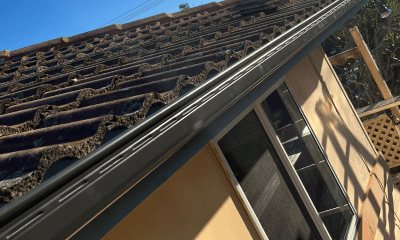
Is the new roofline a downgrade in looks?
This is a fair question and it deserves a straight answer. Yes, the roofline changes. A conventional setup has a visible fascia line where the old profile presented as one uninterrupted face of steel. Some people notice it, most do not, and on the majority of houses it reads as completely normal because it is what almost everything built since looks like.
What you gain is that the fascia and the gutter can be chosen to work with the roof and the rest of the house rather than being whatever colour the original section happened to be. In practice most homeowners end up preferring the finished look, because it is a fresh roofline rather than a tired one.
What goes back on when the old system comes off
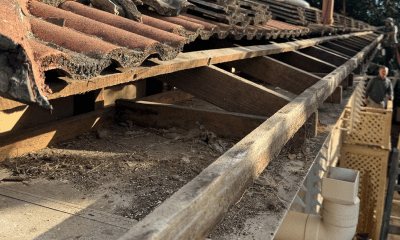
Once the old profile is removed there is no fascia on the house at all, so the replacement is not a like-for-like swap — it is a conversion. In broad terms the new roofline consists of:
- A new fascia, timber or metal, fixed to the rafter ends
- The roof sheeting re-laid, re-fixed and sealed over the new edge
- A separate gutter, typically Colorbond, in a chosen profile and colour, hung on brackets and set to fall
- Outlets and downpipes sized and run so the roof actually drains and meets code
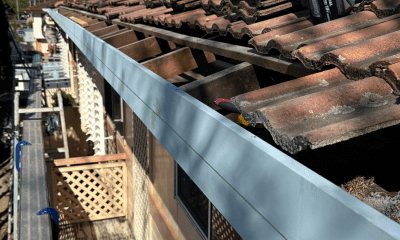
The full detail of how that job runs, what to look for on your own roof and what drives the price is on our Nu-Line gutter replacement page.
A note on who we are, and who we are not
We are not affiliated with ACE Gutters and we are not affiliated with BlueScope or Colorbond. We do not supply, sell or represent either. We are licensed roof plumbers who remove old all-in-one fascia gutter systems and install conventional separate fascia and gutter in their place. Nothing on this page is a criticism of a manufacturer — it is a description of how two different roofline designs behave when they get old.
Common questions
Can I get a new Nu-Line section to match what is on my house?
Matching sections for these older systems are not something you can readily pick up, which is a large part of why a like-for-like patch is not on the table even when the rest of the run looks acceptable.
Is Colorbond gutter better than what I have now?
It is not really a better-or-worse comparison, because they are different categories — one is a material, the other is a roofline design. The practical gain is not the steel; it is that the gutter is a separate part from the fascia, so any future problem can be dealt with on its own instead of turning into a roof job.
Do I have to use Colorbond for the new gutter?
It is what we typically use, because it is well suited to the climate here and comes in profiles and colours that suit most homes. If you have a preference or the house calls for something else, tell us when we quote and we will talk it through.
Can the new gutter be a different colour to the roof?
Yes. That is one of the practical benefits of separating the two components — the fascia and gutter can be matched to the roof, matched to the trim, or deliberately contrasted. It is your call, and it is worth deciding before the material is ordered.
Not sure which system you have?
The quickest way to find out is a photo from ground level looking up at the roof edge, plus one of the worst corner you can see. Send those through and we will tell you straight away what you are dealing with and what the options are.
We do this work right through the south-east, including Nu-Line gutter replacement on the Gold Coast, from Coomera down to Coolangatta.
Or call John on 0480 041 400. ★★★★★ Over 150 5-star Google reviews.