
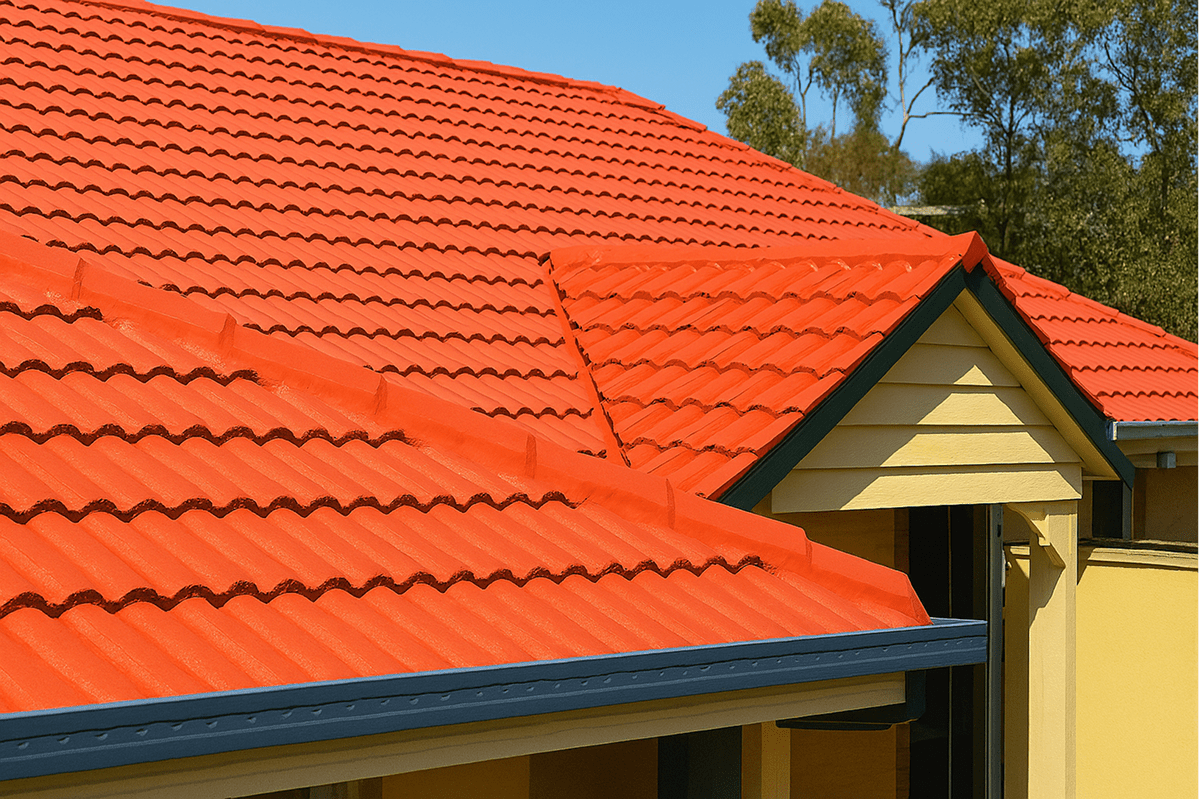
There is no honest fixed price for this job, and anyone quoting a fixed total over the phone has not looked at your house. As a guide, a Nu-Line conversion typically runs $215–$325 per lineal metre including GST — indicative only, with every job measured and quoted on site. The range is wide because you are not buying a length of gutter — you are buying a rebuilt roof edge. That means the quote is structured differently to a standard re-gutter quote, and it needs to be read differently too.
This article gives you the guide rate and, more usefully, what sits behind it: how a Nu-Line quote is put together, which parts of it can be fixed up front and which genuinely cannot, and the questions that separate a real quote from a guess. If you want the background on what the system is and why it has to be converted rather than patched, that is covered on our Nu-Line gutter replacement page.
Why a Nu-Line quote is not a re-gutter quote
A standard re-gutter quote is close to a shopping list. So many lineal metres of gutter, so many brackets, so many downpipes, a day or two on site, done. The fascia the gutter hangs off is already there and is not part of the job.
On a Nu-Line roofline there is no fascia. The old section was doing both jobs, so the moment it comes off, the house has nothing to hang a gutter from. The quote therefore has to cover three separate pieces of work — opening and re-laying the roof edge, building a fascia where none existed, and then installing the new guttering — rather than one. That is the structural reason the total sits higher than the re-gutter quote on the house next door, and it is why the two numbers should never be compared directly. To put it in figures: a standard re-gutter runs $88–$105 per lineal metre including GST, while a Nu-Line conversion typically runs $215–$325 — same street, completely different job.
How the quote is actually built
A properly written quote for this work should let you see the shape of the job, not just a total at the bottom. These are the components that go into it:
- Measured roofline. Everything starts with lineal metres of roof edge, measured off the actual house — not estimated off a photo or a floor plan. Every other figure scales from it.
- Access and set-up. Ladders, a scaffold, or a lift — decided by height, ground conditions and what is sitting under the roofline. On a tight block or a sloping site this is a real line item, not an afterthought.
- Removal and disposal. The old steel has to come off in lengths and leave the site. That is labour and tip fees, and it applies before a single new component goes on.
- Roof edge work. Releasing the sheeting, turning it back, then re-laying, re-fixing and sealing it once the new fascia is in.
- New fascia. Material and labour for a fascia that did not previously exist, fixed to the rafter ends straight and true.
- Guttering, outlets and downpipes. The part that looks like a normal re-gutter — profile, colour, brackets, stop ends, and the downpipe runs into the existing stormwater.
- Timber repairs — the honest unknown. Nobody can see the rafter ends until the old system is off. A good quote says clearly how this is handled rather than pretending it will not come up.
If a quote for a Nu-Line conversion arrives as a single line with a single number and no mention of fascia or roof edge work, that is worth a question or two before you sign anything.
The one part that cannot be priced up front
This is the part that catches people out, so it is worth being blunt about it. The rafter ends have been sitting behind a rusting steel section with water running over them, possibly for decades. Until that section is peeled off, nobody — no matter how experienced — can tell you exactly what is behind it.
There are only two honest ways to handle that in a quote. Either the timber work is carried as an allowance that is adjusted against actual work done, or it is excluded and priced when the extent is known. Either is fine, provided you are told which one you are getting before the job starts, and provided you are shown the timber before any extra work is agreed. What is not fine is a quote that stays silent on it and then turns into a surprise on day two.
Ask the question directly: “What happens if the rafter ends are rotten, and how will you show me?” The answer tells you a great deal about who you are dealing with.
Why two houses on the same street quote differently
Homeowners often compare notes with a neighbour and find the figures are nowhere near each other. Usually nothing is wrong — the two jobs are simply not the same job. The things that move a Nu-Line quote most are the ones you cannot see from the street:
- Metres, not floor area. A long, spread-out single storey can carry far more roof edge than a taller, more compact house with the same number of bedrooms.
- How the work has to be staged. A roofline that can be done in one continuous run is more efficient than one broken up by levels, awnings, a carport or a pergola that has to be worked around.
- What sits underneath. Pools, retaining walls, established gardens and paved areas all change how access is set up and protected.
- Corners and changes of direction. Hips, valleys and gables take time that a straight run of the same length does not.
- Where the water has to go. If the existing downpipe and stormwater layout was never adequate, fixing it is part of doing the job properly rather than a bonus extra.
- Condition of the timber. Two identical houses can diverge sharply here, and it is the single biggest reason a neighbour’s final figure differs from yours.
What to ask when you compare quotes
Comparing totals is the least useful thing you can do with three quotes for this job, because the totals may not be covering the same work. Compare these instead:
- Does it include the new fascia? It has to. If a quote does not mention fascia at all, either it has been missed or the quoter has not understood what they are looking at.
- Does it include releasing and re-laying the roof sheeting? The old section cannot come off without it, and a roof edge put back badly is worse than the gutter you started with.
- Who is doing all three parts? One crew and one point of contact, or three separate parties you have to coordinate yourself.
- How is timber repair handled? Allowance, exclusion, or silence. Silence is the problem.
- Is removal and disposal in the price? Old steel does not walk off site on its own.
- What profile and colour, and are downpipes included? These change the material figure and are easy to leave vague.
- Are they licensed, insured, and is the work guaranteed? This is roof plumbing on a structural edge, not handyman work.
Run those seven questions across every quote and the cheapest one often stops being the cheapest — because it turns out it was not quoting the same job.
Be careful with a figure that looks too good
There is no genuinely cheap version of a Nu-Line conversion, and a quote well under the others — or well under the bottom of the guide range — is a signal rather than a bargain. It usually means one of three things: the fascia has been left out, the roof edge work has been left out, or the person quoting is planning to walk once they see what is behind the steel. The cost of picking that job up halfway through is always higher than doing it once, properly.
Quick answers on pricing
Can you quote a Nu-Line replacement from photos?
Photos are excellent for confirming what system you have and whether the job is one we take on. They are not enough to price it, because the metres, the access and the roof edge all have to be checked in person.
Do you charge for the quote?
No. Quotes are free and obligation-free. Sending a photo through first speeds it up — one from ground level looking up at the roof edge, and one of the worst corner you can see.
Can I do one elevation now and the rest later?
You can, and sometimes that is the right call for a budget. Be aware it is generally less efficient per metre than doing the lot in one visit, and the untouched runs keep deteriorating in the meantime. We will tell you honestly which way makes sense for your house.
Getting a real number for your house
The $215–$325 per lineal metre guide above is genuine, but a guide range is not a price for your house. What we will do is come out, measure the roofline, look at the access and the condition of the steel, and give you a figure for your house with the assumptions written down so you can see exactly what it covers.
If you are in the south-east, most of this work is Nu-Line gutter replacement across Brisbane, and we cover the Gold Coast and Logan as well.
Want it looked at properly? Call John on 0480 041 400. ★★★★★ Over 150 5-star Google reviews.